Home / Solutions / Livestream Display
Rear-Camera Livestream Display Development
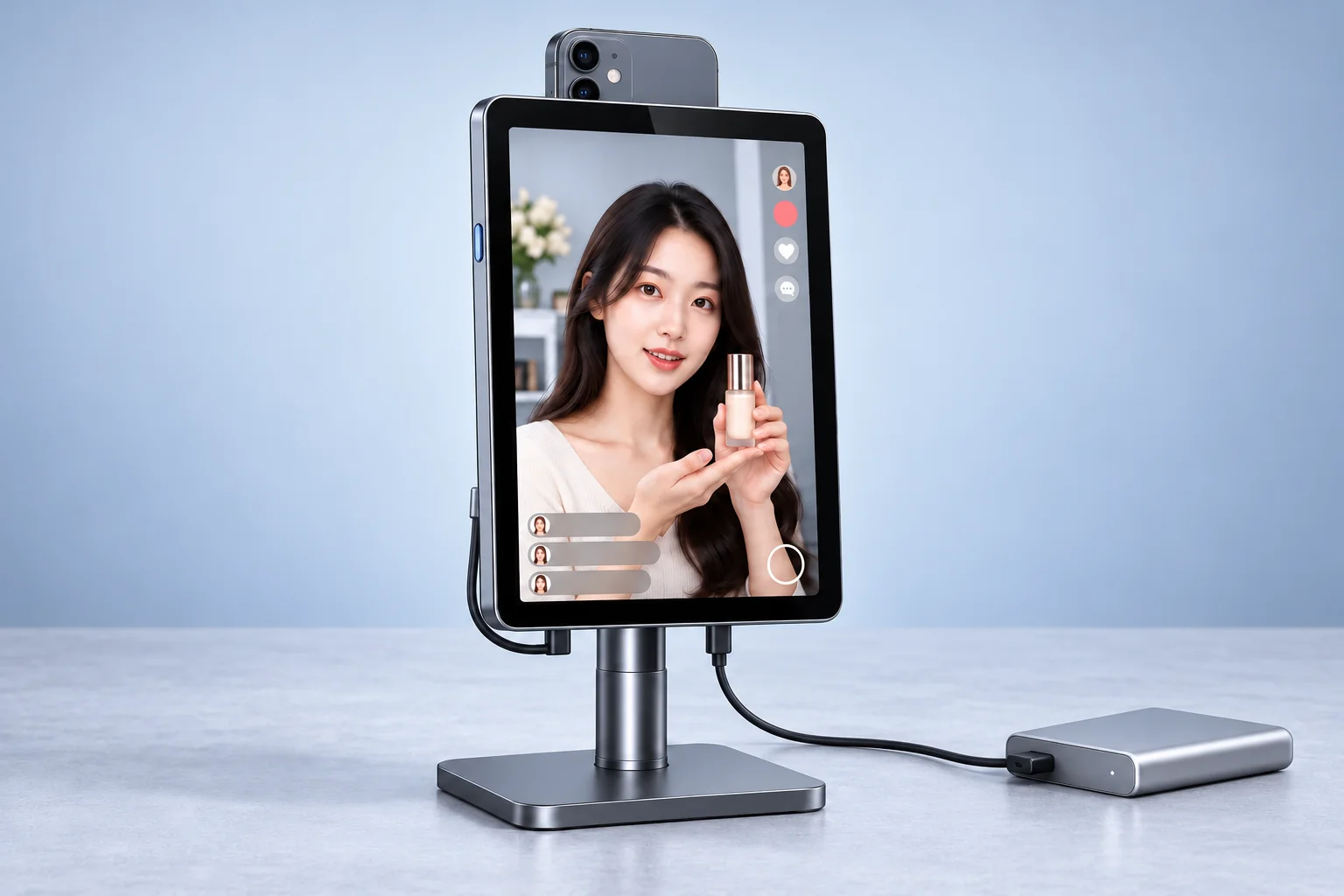
For desktop livestreaming and rear-camera monitoring. View and control the phone's rear-camera feed on a larger touchscreen, with the larger display, phone mounting, power and cable layout planned around your product.
Use cases
Framing and monitoring on the desktop.
A bigger screen is not automatically better. Desktop usability depends on where the phone is mounted, how the cables run and how power is supplied — all of which are decided together with your actual shooting setup.
Live selling
With the phone fixed at a desktop position, view product details and focus on the larger screen.
Talking-head and tutorial shooting
When you need to speak and check composition at the same time, a larger picture makes framing and content easier to confirm.
Product detail shots
When shooting small items, a larger picture helps judge whether focus and detail are on target.
Fixed desktop positions
Stability, thermal behavior and power for long sessions need separate planning and must be tested in the actual setup.
These are product directions, not a claim that any performance figure has been achieved. Display size, phone mounting and power are confirmed against your product definition.
Development progress and demos
What we have brought up, and where the limits are.
The progress below reflects development on the existing solution. Display specifications, phone models and supported features are confirmed per project; we do not make untested performance claims.
- 10.1-inch displayBrought up. Exact pixel count, refresh rate and brightness depend on the panel and are confirmed per project.
- USB-C DP Video InputA phone outputs DP video over USB-C to the display. A USB-C port does not mean a phone supports DP video output — this is checked per phone model before connection.
- Touch ControlOperating the phone from the touchscreen is implemented. Which phone models, systems and apps are supported is confirmed per project, item by item.
- Not yet verifiedThermal behavior and stability over long livestreams, charging the phone at the same time, and behavior while charging and in use all need to be tested and confirmed in the real setup.
No demo video is published yet. Contact us about demo and sample arrangements.
Customizable items
What a desktop product has to solve.
Every item below can be discussed on its own. Each is assessed against its actual scope — this is not an all-inclusive package.
Display and panel integration
Panel selection and display driver integration assessed by size, aspect ratio and target resolution.
Phone mounting and structure
Rear mounting position, exposed area and fixing method determined together with your structural design.
PCBA dimensions and connector positions
Board shape, thickness and connector positions determined together with the base or enclosure structure.
Image orientation and display layout
Portrait/landscape, rotation and mirroring adjusted to the actual desktop position, with touch mapping checked at the same time.
Touch and interaction
Touch and phone control support confirmed per phone model, system and app.
Power and cable layout
How the display, phone and external power connect, plus cable length, routing and fixing.
Connection and compatibility
Wiring decides whether the desktop setup works.
Video connection, power and touch control are three separate things and must be verified separately. Phone model, system version and the specific app all affect the result.
- Video connectionUSB-C DP wired input is used. The phone itself must support DP video output; the same connector shape does not mean it does.
- Phone mountingWe recommend mounting the phone directly behind the display with its top edge exposed, for framing and airflow; the actual structure is determined by your industrial design.
- PowerThe display and the phone need separate power planning. Whether both can be powered at once, or used while charging, is confirmed after per-project testing.
- CablesCable length, bend radius and fixing affect desktop usability; we recommend settling these together with the industrial design at the structure stage.
- Touch controlImplemented; the controls actually available are confirmed per phone model, system and app.
- Long sessionsWe recommend testing thermal behavior, brightness and stability in the real use case; continuous-run testing can be added to the validation plan.
Route comparison
Choose the development route that fits.
Each route suits different situations. The table below is a route comparison only and does not refer to any specific company or chip combination.
| Focus | Wireless Casting | General Wired Display | Idea to Device Custom Development |
|---|---|---|---|
| Video connection | Wi-Fi or a paired transmitter/receiver | DP / HDMI and others | USB-C DP |
| Touch control | Depends on product and protocol | Depends on phone and solution | Implemented; exact support per project |
| Display options | Depends on platform and model | Depends on driver and panel | 3.5 / 4.0 / 10.1 inches brought up |
| Architecture focus | Wireless transmission and decoding | Interface conversion and driving | Integrated display processing and control |
| Delivery | Per supplier | Per supplier | Custom PCBA or reference design |
Each route suits different situations; final display specifications, phone compatibility, power and delivery terms are confirmed per project.
Delivery and contact
Settle the desktop setup first, then the display and structure.
Delivery is a custom PCBA, or an agreed reference design with pre-programmed firmware chips. Scope, timeline and acceptance criteria are agreed at the start of the project.
See the customization and delivery process